
Keyword research doesn’t have to drain your budget. Whether you’re launching a new website or refreshing your content strategy, you can uncover valuable search terms without spending a cent on premium tools.
I’ve spent years helping businesses find their audience through organic search, and here’s what I’ve learned: the best keyword insights often come from combining free resources in creative ways. You’ll discover search terms your competitors miss, understand what your audience actually wants, and build content that ranks—all without subscription fees.
This guide walks you through ten proven methods that work right now. Some tap into Google’s own data, others leverage community platforms, and a few use clever workarounds with freemium tools. By the end, you’ll have a complete keyword research process that costs nothing but your time.
Quick Takeaways:
- Google’s free tools (Search Console, Autocomplete, People Also Ask) reveal real search behavior from your target audience
- Reddit, Quora, and online communities expose the exact language people use when discussing your topics
- Competitor analysis through their public content shows you proven keywords already driving traffic in your niche
- Combining multiple free methods gives you better insights than relying on a single paid tool
- You can find low-competition keywords with high intent by analyzing questions and long-tail phrases
1. Mine Google Search Console for Hidden Gems
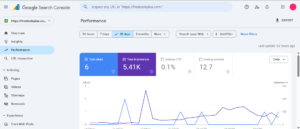
If your website’s been live for even a few months, Search Console holds your most valuable keyword data. You’re already ranking for terms you didn’t target—often hundreds of them.
Head to the Performance report and sort by impressions. Look for keywords where you’re showing up on pages 2-3 (positions 11-30). These represent low-hanging fruit. You’re close to page one, which means a content refresh or some strategic internal linking could push you into click territory.
I’ve seen websites double their traffic by optimizing existing content around these “almost ranking” keywords. The search intent is already validated because Google’s showing you for these terms. You just need to strengthen your relevance.
Pay special attention to queries with high impressions but low clicks. This mismatch often signals that your meta description or title isn’t compelling enough, not that the content is weak.
2. Exploit Google Autocomplete Systematically

Google Autocomplete isn’t just convenient—it’s a direct window into what people search for. Google shows these suggestions based on actual search volume and trends, making them incredibly reliable.
Start by typing your main topic into Google, but don’t hit enter. Note the suggestions. Then add a space and the letter ‘a’ after your keyword. Write down those suggestions. Repeat with ‘b’, ‘c’, and so on through the alphabet.
This “alphabet soup method” uncovers long-tail variations you’d never think of on your own. For example, “content marketing” might reveal “content marketing for beginners,” “content marketing examples,” and “content marketing jobs”—each representing different search intent.
You can also try adding question words before your keyword: “how to,” “why does,” “can you,” “what is.” These modifiers surface informational queries that are perfect for blog content.
3. Reverse-Engineer Competitor Keywords
Your competitors have already done keyword research. Why not learn from their work? Visit their top-performing pages and analyze what they’re targeting.
Look at their URL structure first. Many sites include their target keyword in the slug. Then scan their H1, H2 headings, and the first 100 words of content. These prime locations usually feature their main keywords.
Check their blog archives or resource sections. The topics they cover repeatedly indicate profitable keywords. If a competitor has published five articles about “email deliverability,” that topic probably drives meaningful traffic.
Don’t just copy their keywords, though. Look for gaps—topics they haven’t covered or questions they answered poorly. These gaps represent your opportunity to rank for terms without fighting established competition.
4. Tap Into Reddit’s Authentic Language
Redditors don’t use marketing speak. They ask real questions using the exact words your target audience uses in private. This makes Reddit invaluable for discovering how people actually talk about your topic.
Find subreddits related to your niche and sort posts by “Top” for the past year. Read through the most-upvoted posts and comments. Pay attention to recurring pain points, questions, and terminology.
Use Reddit’s search function within relevant subreddits. Search for broad terms related to your topic, then note the specific phrases that appear repeatedly in discussions. These conversational keywords often have less competition because marketers overlook them.
I’ve found some of my best content ideas this way. Someone asking “Why does my website load slow on mobile but not desktop?” becomes a perfectly optimized article title that matches real search behavior.
5. Harvest Questions from People Also Ask
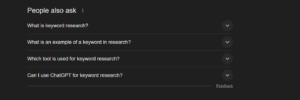
Google’s People Also Ask (PAA) boxes expand every time you click one. This creates a virtually endless stream of related questions people actually search for.
Search for your main keyword and click the first PAA question. Google loads more questions. Click another, and more appear. Keep going until you’ve collected 20-30 related questions.
These questions reveal the searcher’s journey. Someone searching “SEO basics” might see PAA questions about “how long does SEO take” and “do I need an SEO agency.” Each question represents a separate keyword opportunity and search intent.
Group similar questions together—they might work as H2 sections in a comprehensive guide. Or turn each into a standalone article if the topic warrants depth.
6. Use Answer The Public’s Visual Approach
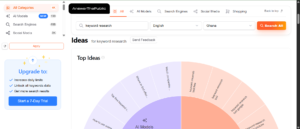
Answer The Public visualizes questions, prepositions, and comparisons around your keyword. The free version limits you to a few searches per day, but those searches are thorough.
Enter your keyword and select your country. The tool returns hundreds of question-based keywords organized by who, what, where, when, why, and how. You’ll also see prepositions (for, without, with) and comparisons (versus, vs, or).
The visual wheel format helps you spot patterns. If most questions cluster around “how,” you know your audience wants tutorials and guides. Heavy “versus” results indicate comparison content performs well in your niche.
Export the data if possible, or screenshot the results. These questions form a content roadmap that directly addresses what people want to know.
7. Analyze YouTube Autocomplete and Comments
YouTube is the world’s second-largest search engine. People search there differently than Google, often using more conversational, long-tail phrases.
Type your topic into YouTube’s search bar and watch the autocomplete suggestions. These represent popular video searches. Even if you’re creating written content, these keywords show you what format and angle resonates with your audience.
Browse top videos in your niche and read the comments. People ask questions, request specific information, and discuss pain points. These comments are keyword gold—they’re unprompted expressions of what your audience wants.
One content creator I know builds her entire editorial calendar from YouTube comments on competitor videos. She answers questions that popular channels ignore, capturing traffic they’re leaving on the table.
8. Leverage Quora’s Question Database
Quora users ask detailed, specific questions about every imaginable topic. The platform’s voting system surfaces the most common concerns, making your research more efficient.
Search for your main keyword on Quora, then click through to relevant questions. Check the view count—higher numbers indicate popular topics that likely translate to search volume.
Read through answers to understand what information people find valuable. If an answer has hundreds of upvotes, those points probably need to be in your content too.
Follow topics related to your niche. Quora will email you new questions as they’re asked, giving you fresh keyword ideas and content angles regularly.
9. Study Amazon Book Titles and Reviews
Amazon’s search behavior mirrors Google’s in many ways. Book titles in your niche reveal what topics have commercial appeal and what language resonates with buyers.
Search for books related to your topic. Look at bestsellers and highly-rated books. Their titles and subtitles often include powerful keyword phrases that balance searchability with curiosity.
Read 3-star reviews especially. These contain honest feedback about what the book lacked or what readers wanted more of. These gaps represent content opportunities and keyword angles that existing content doesn’t fully address.
The “Customers also bought” section shows related topics and angles. If several books about “content strategy” appear alongside “SEO,” that combination might be worth targeting together.
10. Combine Free Tool Trials Strategically
Most premium keyword tools offer free trials. While you can’t rely on them long-term without paying, you can strategically use trial periods to build a massive keyword list.
Sign up for Ubersuggest, Moz, or similar tools and immediately export as much data as possible. Focus on getting keyword lists, competition analysis, and search volume estimates for your main topics.
Use these exports as your baseline data. Then maintain and expand your list using the other free methods in this guide. You’re essentially using the trial to jumpstart your research, not depend on it.
Space out your trials over months as your content needs evolve. If you need data for a new content pillar six months from now, that’s when you start another trial.
Putting It All Together: Your Free Keyword Research Workflow
Here’s how to combine these methods into a repeatable process. Start with Google Search Console if you have existing traffic—it shows you what’s already working.
Next, use Google Autocomplete and People Also Ask to expand your seed keywords into long-tail variations. This gives you breadth. Then go to Reddit and Quora for depth—understanding the real questions and pain points behind those keywords.
Run your expanded list through a free trial tool if needed, or simply prioritize based on relevance and competition. Create a spreadsheet tracking each keyword, its source, estimated difficulty, and intended content angle.
Finally, validate your picks by checking if top-ranking content actually answers the query well. Weak existing content means opportunity. Strong comprehensive content means you’ll need a differentiated angle.
Common Keyword Research Mistakes to Avoid
Don’t chase high-volume keywords exclusively. A keyword with 50,000 monthly searches and a page one full of major publications isn’t accessible for most sites. Look for keywords where the top results are mediocre or from sites similar to yours in authority.
Avoid ignoring search intent. A keyword might seem perfect until you realize people searching it want something different than what you’re offering. Always check the actual search results to understand what Google thinks belongs on page one.
Don’t forget to organize as you research. A messy pile of 500 random keywords is useless. Group them by topic, search intent, and content format as you go.
Measuring Your Keyword Research Success
Good keyword research pays off in rankings and traffic, but give it time. Most content takes 3-6 months to reach its full ranking potential.
Track your target keywords in Search Console. Watch for upward movement in average position and increases in impressions. These leading indicators show Google finds your content relevant before you see major traffic spikes.
Monitor which keywords drive actual conversions or engagement, not just traffic. A keyword bringing 1,000 visitors who immediately bounce is less valuable than one bringing 100 engaged users who read your content and take action.
Revisit your keyword research quarterly. Search trends shift, new competitors emerge, and your site’s authority grows. What seemed impossible to rank for six months ago might be achievable now.
Your Next Steps
Start with just one method from this list today. If you have a website, log into Search Console and spend 30 minutes finding your “almost ranking” keywords. No website yet? Hit Reddit and spend an hour reading discussions in your target niche.
Keyword research isn’t a one-time project—it’s an ongoing practice. The sites that dominate organic search consistently look for new opportunities and adapt to changing search behavior.
You now have ten proven methods that cost nothing but time. Pick one, get started, and build from there. Your next high-traffic article is hiding in plain sight, waiting to be discovered through smart, systematic research.