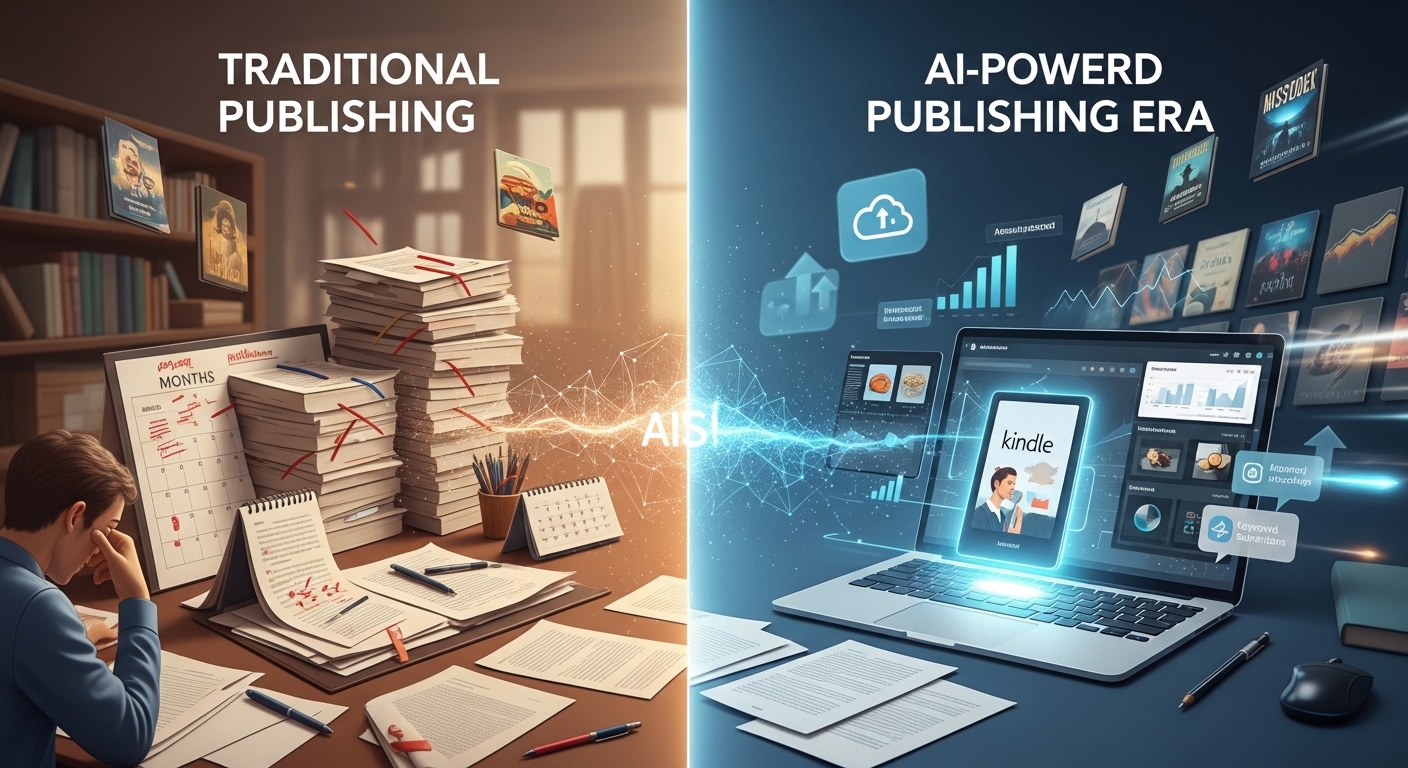
You’re browsing for your next read, and two books catch your eye. Same genre, similar covers, identical price points. One took an author three years to write and polish. The other was generated with AI assistance in three weeks.
Can you tell the difference? More importantly, should you care?
The debate between AI ebooks vs traditional ebooks isn’t about technology versus humanity. It’s about understanding what you’re actually paying for when you buy a book. Both types sit on the same virtual shelves, compete for the same readers, and cost roughly the same amount. But they come from fundamentally different creative processes, and those differences show up in unexpected ways.
Quick Takeaways:
- Traditional ebooks typically show deeper character development and more nuanced emotional arcs because they’re crafted over months or years
- AI-generated ebooks excel at formulaic genres like romance tropes or business frameworks but struggle with originality and surprise
- Price doesn’t indicate which type you’re buying—both range from $0.99 to $9.99 depending on market positioning
- Reading samples reveals the difference: AI content often uses repetitive phrases and explains emotions rather than showing them
- The quality gap is narrowing as authors learn to use AI as a tool rather than a replacement for creativity
The Reading Experience: Where You’ll Notice the Difference
Let’s start with what actually matters when you’re curled up with your Kindle. Traditional ebooks tend to have what readers call “texture.” The prose has rhythm. Sentences vary in length and structure naturally. You’ll find unexpected word choices that surprise you in a good way.
AI ebooks often feel smoother but blander. The grammar is perfect. The pacing is consistent. But there’s a sameness to how ideas flow. If you pay attention, you’ll notice certain phrases appearing more frequently than they should.
Character voices pose the biggest challenge for AI. In traditionally written books, each character speaks distinctly. You could probably identify who’s talking without dialogue tags. AI struggles here because it’s pattern-matching, not creating personalities from scratch.
Emotional beats land differently too. A human author knows when to slow down for a tender moment or speed up for tension. They’ve felt these emotions themselves. AI can describe sadness or joy accurately, but the timing often feels slightly off, like a musician who’s technically proficient but can’t quite feel the music.
Plot Structure: Formula vs Craft
AI excels at following established story structures. Need a three-act structure with all the right beats? AI can deliver that flawlessly. It knows where the inciting incident goes, when to introduce conflict, and how to build toward a climax.
But here’s the catch: readers have seen these structures thousands of times. What makes a story memorable isn’t hitting the beats—it’s knowing when to subvert them. Traditional authors develop instincts about when to zig instead of zag.
I’ve read AI-generated mysteries where the clues are perfectly placed and the reveal happens at exactly the right moment. They’re competent. They’re even entertaining. But I’ve never been genuinely shocked by one. The “twists” feel like they came from a template because, well, they did.
Traditional ebooks show their human origins in the messy middle sections. That’s where authors often struggle, and it shows. But it’s also where the most interesting creative decisions happen—the subplot that doesn’t quite fit standard structure but adds depth, or the character moment that derails the plot momentarily for emotional payoff.
Genre Makes a Massive Difference
Some genres barely show the difference between AI and traditional creation. Business books, self-help guides, and educational content often benefit from AI’s organizational strengths. These books succeed based on clear information delivery, not creative storytelling.
Romance readers report mixed experiences. Trope-heavy romances (fake dating, enemies to lovers, forced proximity) work surprisingly well with AI assistance because these books follow predictable patterns readers actively want. The comfort comes from familiar structure with slight variations.
But literary fiction? That’s where AI falls apart. Books that rely on subtle themes, unreliable narrators, or experimental structure need human judgment at every turn. AI can’t write like Kazuo Ishiguro or Virginia Woolf because those styles come from deeply personal artistic visions.
Thrillers and mysteries show the divide clearly. AI can plot competently but struggles with red herrings that feel organic rather than planted. Traditional authors know how to misdirect readers without cheating—that’s a skill developed through understanding human psychology, not pattern recognition.
The Economics Tell an Interesting Story
Traditional ebooks usually cost more to produce but not always more to buy. An author might spend $2,000-$5,000 on editing, cover design, and formatting. They’ll price based on recovering those costs plus making a profit.
AI-assisted ebooks have near-zero production costs. Authors can generate covers, format perfectly, and even write content for under $100 total. But they often price competitively with traditional books because readers don’t want to buy the cheapest option—they want to buy the best value.
This creates a weird market dynamic. A $4.99 AI-generated romance might sit next to a $4.99 traditionally written one. Both authors are profitable, but at vastly different volume requirements. The AI-assisted author needs 500 sales to make $2,000. The traditional author needs 2,000 sales to break even.
Amazon’s Kindle Unlimited program complicated this further. Authors get paid per page read, which rewards volume over quality. Some authors are gaming this system by publishing AI-generated content rapidly, earning steady income through sheer quantity.
Quality Control: The Wild West Problem
Traditional publishers provide a quality floor. If Penguin Random House publishes a book, you know it’s been edited multiple times, fact-checked, and vetted by professionals. That doesn’t guarantee you’ll enjoy it, but it guarantees basic competence.
Self-published traditional ebooks vary wildly. Some indie authors hire professional editors and produce work that rivals traditional publishers. Others skip editing entirely and publish rough drafts. The indie label doesn’t tell you much anymore.
AI ebooks present a new challenge entirely. Some authors use AI for first drafts then revise extensively, essentially using AI as a productivity tool. The final product might be indistinguishable from a traditionally written book. Others generate content, do minimal editing, and publish immediately.
Platforms are struggling to address this. Amazon’s AI disclosure requirements help, but enforcement is spotty. Authors can simply not disclose, and there’s no automated detection sophisticated enough to catch everything.
What Authors Are Actually Doing
Most successful authors aren’t choosing between AI and traditional methods—they’re blending them strategically. They’ll use AI for tasks that don’t require creative judgment and handle the important stuff themselves.
Marketing materials are the most common AI use case. Authors generate multiple versions of book descriptions, test different angles, and optimize for different platforms. This frees up mental energy for actual writing.
Dialogue smoothing is another popular application. Authors write conversations naturally, then use AI to check for consistency in character voice or trim unnecessary words. The creative decisions remain human, but AI handles refinement.
Some authors use AI for world-building in fantasy or sci-fi. They’ll input their rules and have AI generate consistent details about currency, government structures, or magical systems. This maintains internal logic without the tedious spreadsheet work.
Research assistance has become huge. Historical fiction authors use AI to quickly verify period-appropriate details. Contemporary authors fact-check references to technology, locations, or cultural practices. This catches errors before editors see the manuscript.
The Reader’s Dilemma: Should You Care?
Here’s the honest answer: it depends what you want from books. If you read primarily for plot-driven entertainment in familiar genres, AI assistance probably won’t bother you. You might not even notice.
If you value prose style, complex characters, and surprising narrative choices, you’ll likely prefer traditionally crafted books. The human element shows up in ways that matter to readers who pay attention to craft.
Some readers have started treating AI-generated content like they treat fan fiction—enjoyable, often competent, but not held to the same standards as original creative work. It scratches an itch without replacing the real thing.
Price consciousness factors in too. If you read 100+ books yearly, AI-generated content at lower price points might make financial sense. But if you read 10-20 books annually, you’ll probably want each one to be memorable.
The Technical Quality Gap Is Closing
Three years ago, you could spot AI-generated prose immediately. The repetitive phrasing, the awkward transitions, the generic descriptions—they screamed “machine-written.” That’s changing fast.
Modern AI tools produce much cleaner prose. They vary sentence structure better. They use more sophisticated vocabulary. An AI-generated thriller from 2026 is dramatically better than one from 2023.
But here’s what hasn’t improved much: originality. AI still pulls from its training data, which means it’s essentially remixing existing work. It can’t draw from personal experience because it has none. It can’t be truly original because originality requires making creative leaps that don’t follow patterns.
Traditional authors can write something completely weird that breaks genre conventions. They can experiment with structure, voice, or style in ways that might fail but might also create something genuinely new. AI plays it safe because safe is what works most often in its training data.
The Disclosure Problem
Here’s where ethics get murky. Should authors disclose AI usage? If so, how much detail? Does using AI for outlining count? What about editing assistance?
Amazon requires disclosure for “AI-generated content,” but that term is vague. Authors interpret it differently. Some disclose everything. Others only disclose if AI wrote substantial portions of the actual prose.
Readers are split on whether they even want to know. Some deliberately seek out human-only content. Others don’t care as long as the book is good. A growing middle group wants transparency to make informed choices.
The comparison to photography is useful here. When Photoshop emerged, photographers debated disclosure. Now it’s accepted that most professional photos involve digital editing. The question is degree—light retouching versus composite manipulation.
We’re in that awkward transition period with ebooks. Eventually, AI assistance will likely become standard practice for certain tasks, while substantial AI generation remains controversial.
What Traditional Ebooks Still Do Best
Certain elements remain stubbornly human. Humor is one—AI can write jokes, but human humor involves cultural context, timing, and subverting expectations in ways that require genuine understanding of why things are funny.
Memoir and personal narrative obviously require human experience. Even when authors use AI to organize or polish these stories, the core content must come from lived experience. You can’t fake authenticity in this genre.
Social commentary and cultural criticism need human perspective. AI can summarize different viewpoints, but it can’t take a stand or develop a unique argument. Books that challenge readers or present controversial ideas still need human authors willing to own those positions.
Poetry and literary fiction that play with language remain human domains. When every word choice matters and the sound of sentences carries meaning beyond their content, you need a human ear and human intention.
Where This Leaves Us
The AI ebooks vs traditional ebooks debate will continue evolving. Right now, we’re in a messy middle phase where both coexist, often indistinguishably, and readers are developing new literacies to navigate the landscape.
Neither type is inherently better or worse. They serve different purposes. AI-assisted content fills certain niches efficiently and affordably. Traditional craft provides depth and originality that can’t be automated.
Smart readers will probably consume both, consciously or not. You’ll binge AI-generated romances that hit your favorite tropes perfectly, then savor a traditionally crafted literary novel that makes you think for days afterward.
The market will sort some of this out naturally. Readers vote with their wallets and their attention. Books that satisfy find audiences regardless of how they’re created. Books that feel hollow get abandoned, leaving negative reviews.
What still matters most? The same thing that’s always mattered: whether the book delivers what the reader wanted. Sometimes that’s escapism and familiar comfort. Sometimes it’s challenge and originality. Both have value. Both have a place on your digital bookshelf.
The real question isn’t which is better—it’s whether you’re getting what you paid for. As long as you understand what you’re buying, you can make the choice that works for you.